The light, all day.
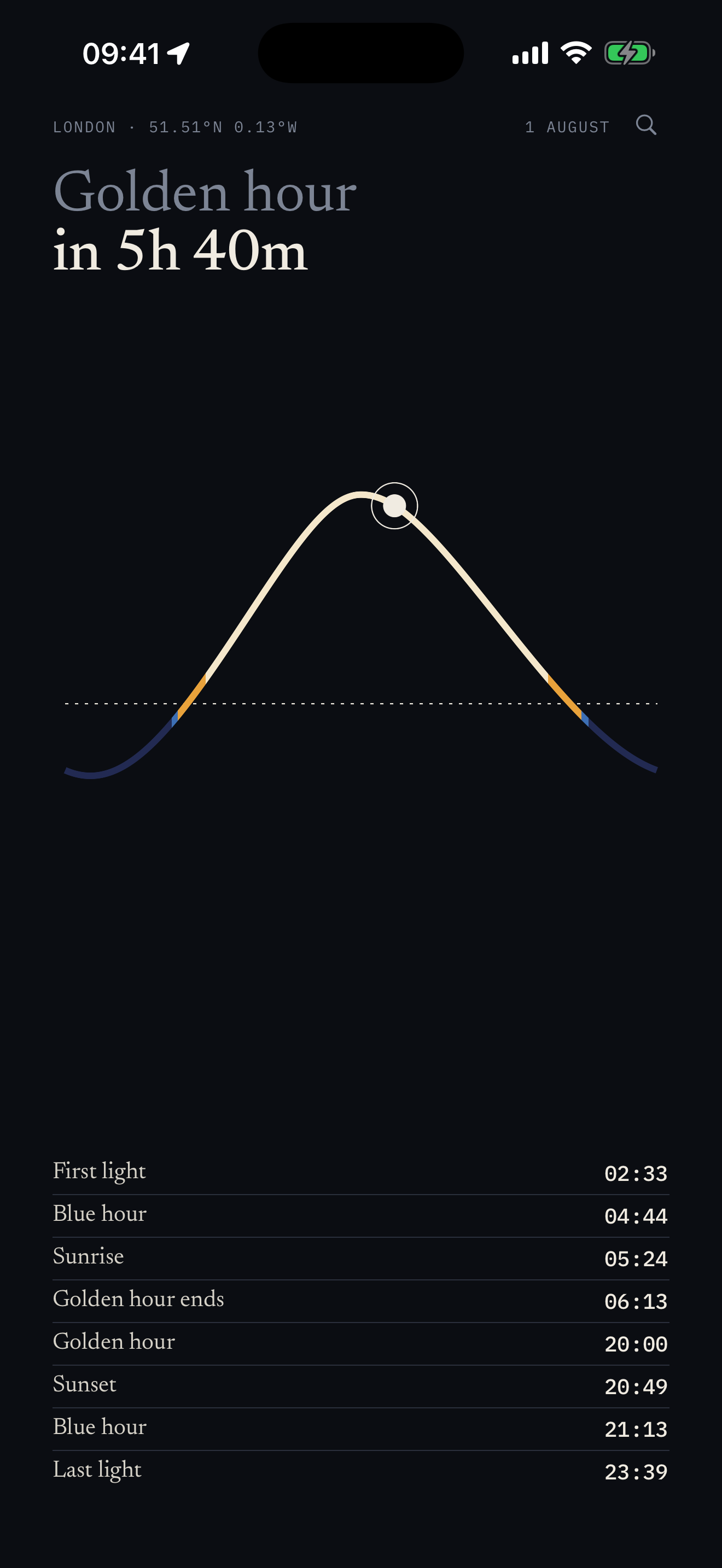
Gild draws today's sun path as an arc, shades the golden and blue hours along it, marks where the sun is right now, and lists the day's eight light times underneath. One screen. Nothing to configure, nothing to set up.
iOS 18 or later · iPhone
One screen, and every number on it is worked out.
Gild is the app you open while walking to a location, not the one you plan a shoot in. There are no tabs, no menus and no settings screen - everything you see comes from four things: where you are, and what day, month and year it is.
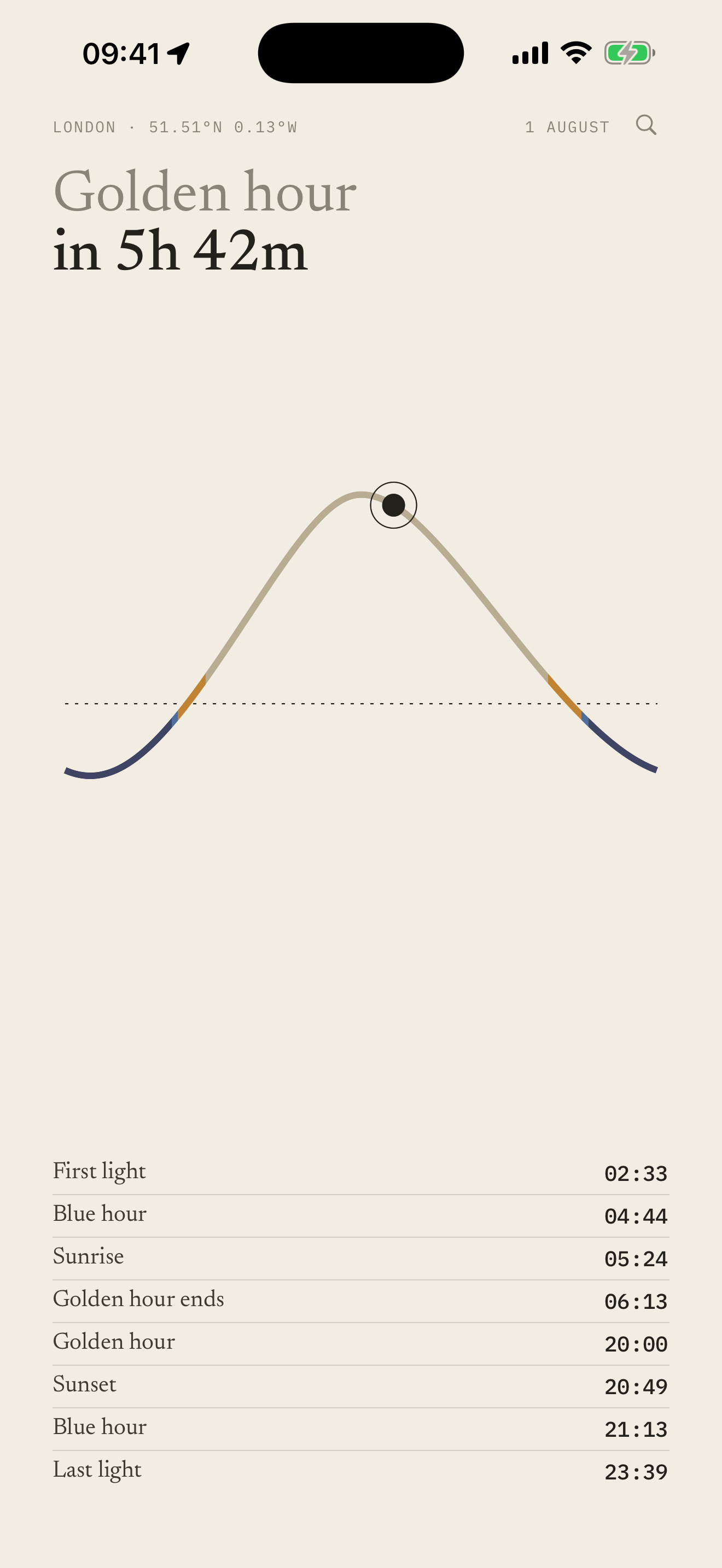
The place and the date across the top, a headline, the arc, and the times list. That is the whole app - glanceable in under two seconds, with nothing to dismiss and nothing to tap before it tells you something.
Blue hour is the sun between −6° and −4°; golden hour runs −4° to +6°, straddling sunrise and sunset. The bands are drawn from today's own crossing times, so the shading is a different shape in June than it is in December.
A filled disc inside a hairline ring sits where the sun is now, and the headline says what that means: Golden hour in 47 minutes, or for 23 more minutes once you're in it. Both update every minute and the instant you come back to the app.
First light, blue hour, sunrise, golden hour ends, golden hour, sunset, blue hour, last light. Always eight rows, in that order, set in a monospaced face so the column lines up on the colon.
Its height is how high the sun actually gets, so a June arc towers over a December one and a tropical noon draws in full instead of flattening against the top. The apex is solar noon, not twelve o'clock - in Britain in June those are over an hour apart.
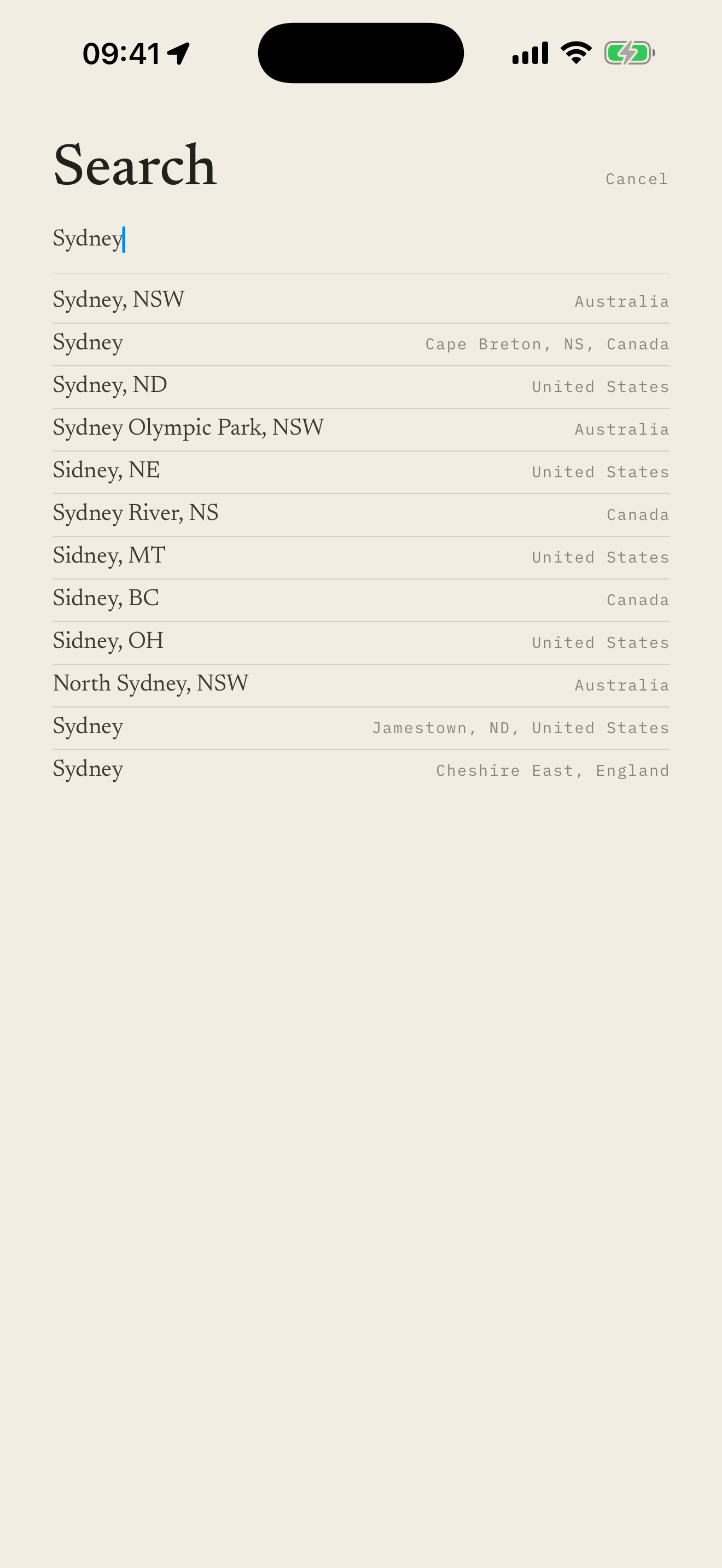
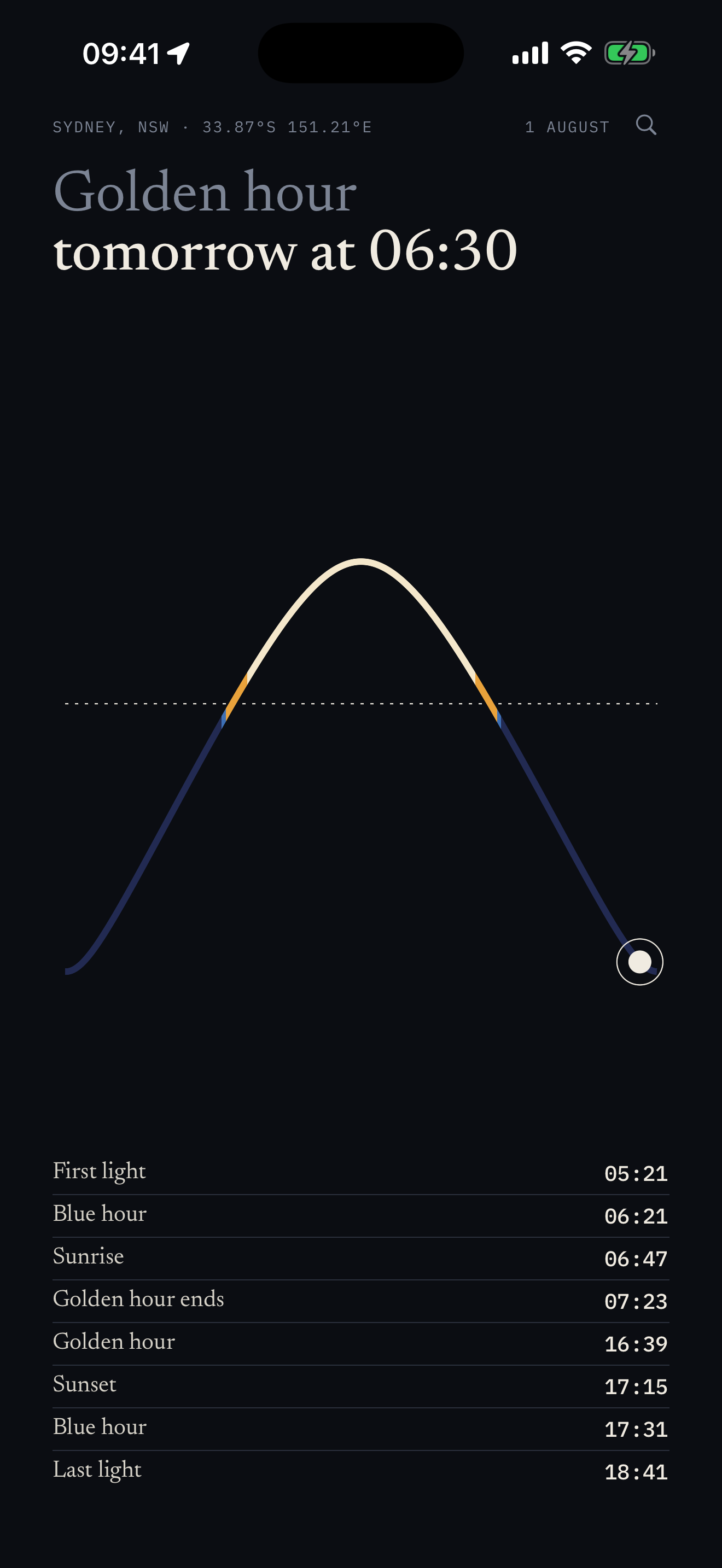
Search a town or a city and see its light on its own clock - Auckland viewed from London shows Auckland's date and Auckland's times. You get places, not streets. Nothing is saved: close the app and you're back where you're standing.
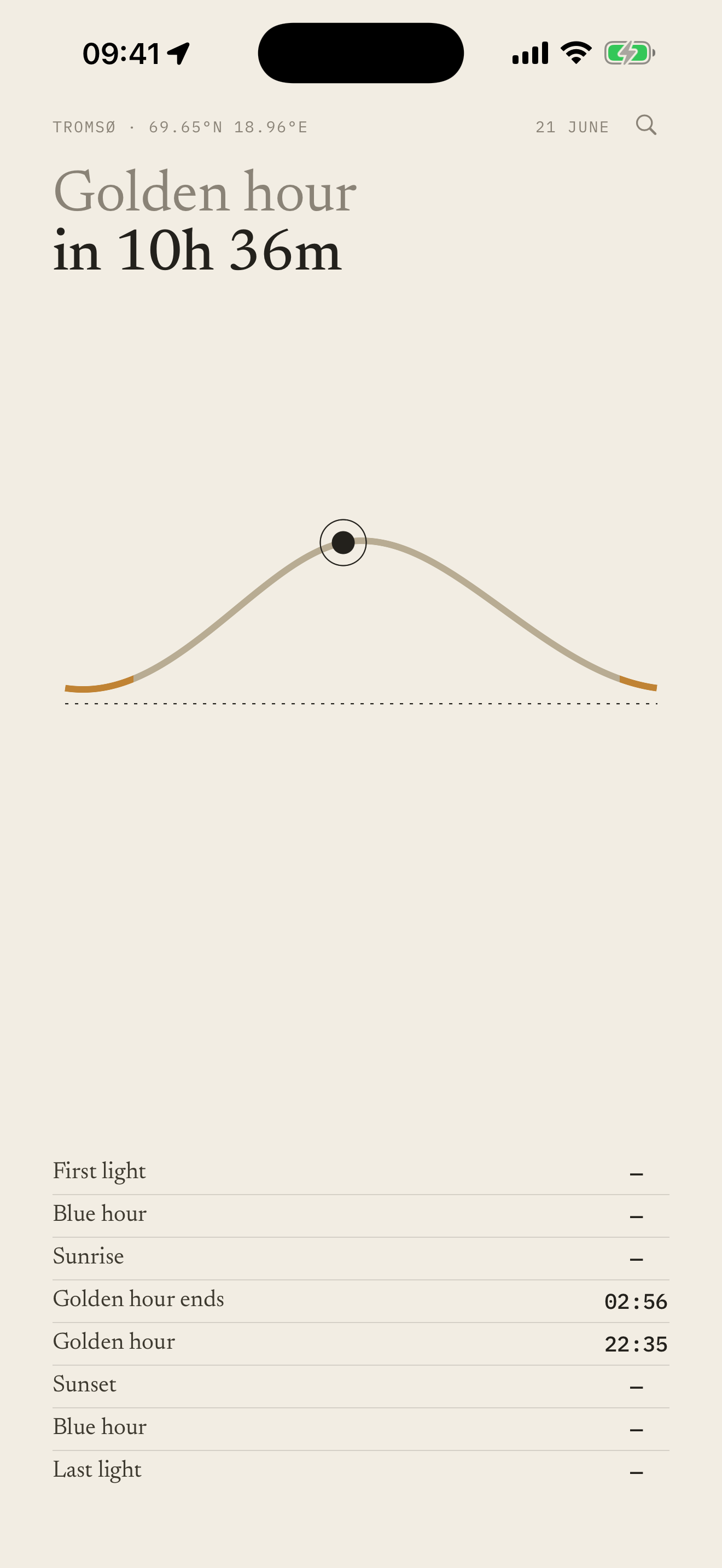
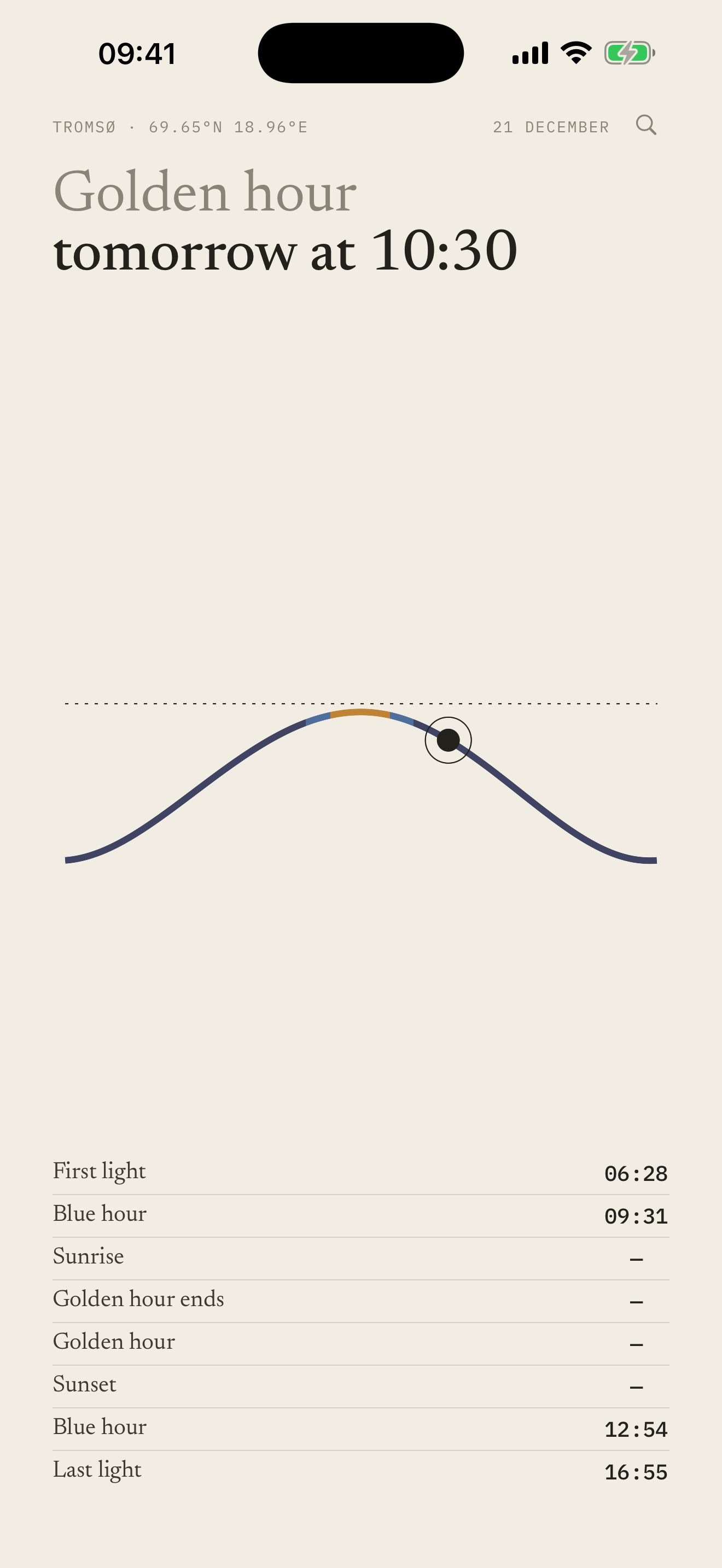
Polar day, polar night and the long summer weeks with no true darkness all draw properly. Where a boundary genuinely doesn't happen, its row shows a dash and stays in the list rather than vanishing or inventing a time.
Every time is computed on the phone from NOAA's solar equations. No forecast, no server, no waiting for a network - and the engine is checked against published tables from the US Naval Observatory, NOAA and JPL Horizons at twelve locations from Quito to Tromsø.
Two appearances that follow your system setting. The dark ramp isn't an inversion of the light one - daylight is the brightest thing on a dark ground and a quiet olive on a pale one, so each band was picked twice.
Four bands, and the angles behind them.
The colours on the arc aren't decoration - each one is a range of solar elevation, measured from the horizon. These constants are the product, which is why the app derives every band edge from the day rather than drawing a shape that looks about right.
Astronomical dawn to civil dawn. First light at one end of the day, last light at the other.
The short, cold band on either side of the golden one. Two rows in the list, both labelled blue hour.
Sunrise and sunset sit inside it, at −0.833° - refraction and the sun's own radius included, not rounded to zero.
The rest of the day. It recedes on a pale ground and goes near-white on a dark one, so the interesting bands stay the loud ones.
Real days, in real places.
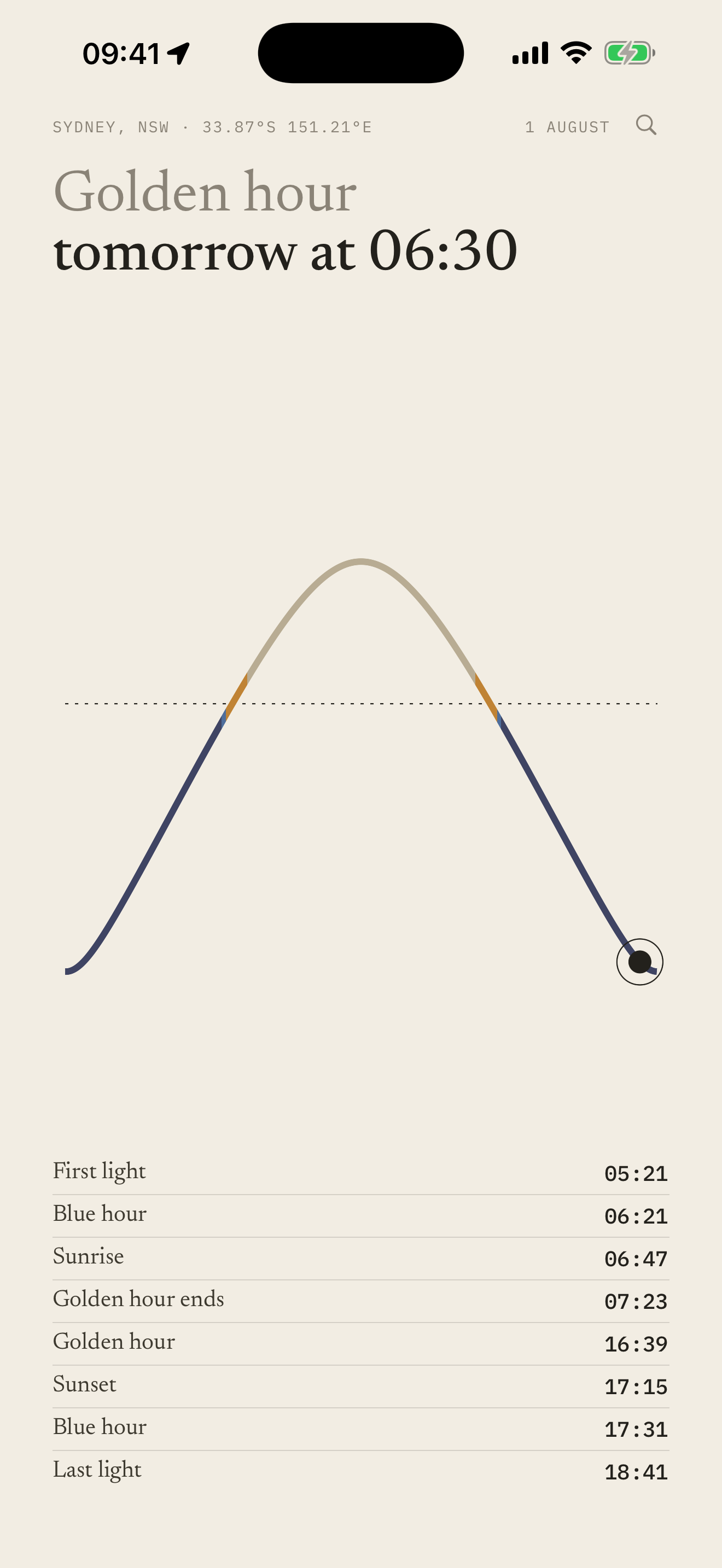
Every capture below is the shipping app: London and Sydney on the same civil date, Tromsø at both solstices, the search sheet, and both appearances. London's times here - 05:24 and 20:49 - are the ones the US Naval Observatory publishes for that day.
Free, and it stays one screen.
Nothing on a single free screen is worth charging for, and a paywall around it would be worse than shipping nothing. There are no adverts, no subscription and no in-app purchases in this version.
Almost everything Gild doesn't do was a decision rather than an omission. Each one is why it opens instantly and never asks you for anything.
No account, no sign-in, no email. Gild has never heard of you and doesn't need to.
No settings screen. There is nothing to configure, so there is nothing to get wrong - the clock format and appearance follow iOS.
Nothing is stored. No saved locations, no history, no files, no database. Every screen is computed and then forgotten.
No notifications, and no notification prompt. Gild asks for exactly one permission: your rough location, and only when you're ready.
No weather. Gild can tell you when the golden hour is; it cannot tell you whether it will be cloudy, and doesn't pretend to.
No analytics, no tracking, no third-party code of any kind. You will never see an App Tracking Transparency prompt from Gild.
All of it, free, on iPhone. Widgets, date scrubbing and saved locations are what a future paid update would add - none of it is held back from this one.
- Sun path arc for today, drawn to scale
- Golden hour and blue hour shaded along it
- Live sun marker, updated every minute
- A headline countdown to the next golden hour
- Eight light times, first light to last light
- City search, each place on its own clock
- Polar day, polar night and partial-absence days
- Light and dark appearances, from your system setting
- No account, no adverts, nothing stored